This Tech Tip is one of an ongoing series we publish to help people maintain their power takeoff clutches. See the following for helpful tips and examples:
- Tech Tip #48: Maintaining Your Twin Disc, Rockford, NACD or WPT Power PTO Clutch,
- Tech Tip #73: How to Make Your Twin Disc, Rockford, NACD or WPT Power PTO Clutch Last Longer,
- Tech Tip #93: Twin Disc® and Rockford Power Take Offs , and
- Tech Tip #154: AutoClutch Power Takeoff Clutches .
We stock and sell a large number of PTOs, clutch packs and PTO components to replace Twin Disc®, Rockford™, NACD® and WPT Power® PTOs in both OEM and aftermarket. Frequently, a customer will ask us to swap the drive pulleys from their old PTO clutch over to the new PTO. That’s when the fun begins. Because pressing pulleys on and off Twin Disc and Rockford clutch shafts isn’t easy.
Over the years we’ve seen a variety of techniques used ranging from torches, beating the pulley off with sledge hammers, to using hydraulic presses to remove pulleys from the PTO shaft. I’d like to share these techniques with you.
1) Torches
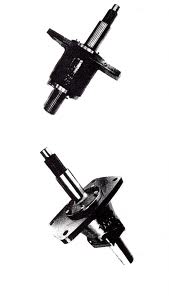 Using heat to remove a pulley from a PTO clutch output shaft is very straightforward. If you don’t have access to a torch, you can usually pick one up fairly inexpensively.
2) Hydraulic Presses
Often on a larger PTO, such as a Twin Disc 318 or a Rockford 4-34510 or a Rockford 4-11060, a sledge hammer or heat isn’t helpful, and as a result many people turn to using a hydraulic press. Beware, though, of using inexpensive poorly made presses. You’re going to need to put some serious pressure on the stubborn pulley and a press for a few hundred dollars could be very dangerous, especially with a large PTO and a great deal of force.
We used to use one of two OTC hydraulic presses in our shop. One was air over hydraulic 55 ton press and the other a hand actuated 12½ ton press. Both had functioning pressure gauges so the operator could see how much pressure he was applying. There are other good brands too and used hydraulic presses are easy to find at machine tool auctions and factory closings.
3) Pullers
OTC has by far the largest assortment of pullers and spreader bars for removing pulleys. Some are used with an impact wrench. You can usually find an assortment of new OTC pullers for sale on eBay for roughly 50% off OTC list price.
4) Types of Pulleys
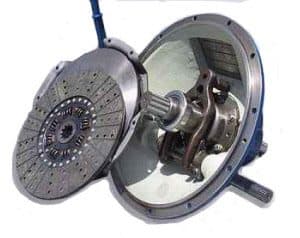 Usually we see PTOs with one of two pulley styles, either a tapered lock pulley or a straight bore-type pulley.
The tapered lock two-piece pulley costs a little more money, but it can be removed much more easily. You simply remove two set screws in the middle of the hub and then put them back in different holes. This will allow you to use a wedge and jack to remove the pulley. If worse comes to worse, and you damage the pulley, usually only the center hub is damaged and that can be replaced. Before you remove the pulley, you need to reference the hub (not the pulley) when measuring the location where the pulley goes on the new PTOs shaft.
There are many good tapered lock two-piece pulleys available and if you damage a straight bore-type pulley you should consider replacing it with a tapered lock pulley going forward.
5) Installing the Pulley on the New PTO Shaft
Okay. You’ve gotten the darn thing off the old shaft without breaking it. Now what? Carefully inspect the end of the output shaft on the new PTO clutch. Because the pulley is really pressed on the shaft (as an “interference fit” component) it is important that the new shaft is not banged up and doesn’t have burrs, etc.
We recommend using what is called “Plumber’s roll” on the end of the new power takeoff output shaft. “Plumber’s roll” is a coarse aluminum oxide paper that comes in a roll 1” wide. You can use it to smooth the shaft out. Finally, you should lubricate the shaft.
We hope that this little Tech Tip will help you the next time you need to change a pulley on a PTO. Please call us toll free at 800.233.6539 if you have any questions.