Helpful tips when ordering your PTO
This Tech Tip, one is a series we publish, is about Twin Disc® and Rockford™ power take off clutch assemblies. It builds on earlier Foley Tech Tips about power take offs. See for example our
- Tech Tip #41, SAE Bell Housings Made Easy,
- Tech Tip #48, Maintaining Your Twin Disc/Rockford Power Takeoff,
- Tech Tip #67, How to Remove a Troublesome Pilot Bearing, and
- Tech Tip #73, Ways to Make Your Twin Disc, Rockford, NACD or WPT PTO Clutch Last Longer.
Ordering OEM or aftermarket replacement components for your PTO from Foley Engines is easy. Afterall, we been stocking the PTO clutch parts and assemblies you need for over half a century. Here are some handy hints.
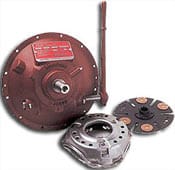 Most people just call us up and give us the numbers from the large inspection plate located on the bell housing of their Rockford, NACD, Twin Disc or WPT Power PTO. Depending on your PTO brand here is the information we need:
Older Rockford PTOs – We need the “PTA” numbers that is most often four digits. For example, a very common older Rockford PTO mounted behind a Ford engine has the assembly number of PTA 4475.
More Recent Rockford PTOs – Rockford later started to us what is referred to as the “Assembly Number”. The assembly number will start with “4-” followed by five digits. For example, a very common 11 1/2″ Rockford power take off has the Rockford Assembly Number “4-34510”. This Rockford clutch assembly might have been attached to a +- 80 horsepower Perkins, John Deere® or Deutz® engine and would have an SAE #3 bell housing. If you want to brush up on what “SAE #3” means you should look at our Tech Tip #41, SAE Bell Housings Made Easy.
NACD PTOs – North American Clutch and Driveline or NACD took over much of Rockford’s mechanical PTO business, but developed its own numbering system. Thankfully, that numbering system is very similar for the duplicate units it produces to replace Rockford PTOs. Also referred to as an “Assembly Number”, these will have six digits followed by “AM”. For example: “419060AM” .
Twin Disc PTOs – Twin Disc typically used a combination of letter and numbers for their “Model Numbers” (a more generalized characterization system) such as SP211HP3, C110HP4, or IBF318P01 and while the model number is helpful, within those models there can sometime be wider variations in PTO design to accommodate specific equipment. No worries, however as also listed on the same PTO tag is usually a Bill of Materials number of “BOM” number. This BOM number usually looks similar to the model number, but clearly defines the specific components used for that particular PTO. The BOM will begin with the broad model definition like SP111, SP211, C111, SP314, etc… followed by the letter “P” and three numbers (ex: SP111P306, SP114P115, CX110P201,etc..).
WPT Power PTOs – WPT Power recently started to change its numbering system. Older unit will typically begin with “WTD-“, followed by two digits that represent the general friction disc size like “08”, “10”, “11”, etc…, followed by a “-” and three digits. A few examples might be WPT-10-190 or WTD-14-192. The new numbering system starts with a “P” followed by two digits that usually reflect the disc dimensions (i.e. P11-, P14-, etc…). It then has two digits, two letters a dash and three numbers (ex.: P11-12AC-000, P14-31AC-002, etc..). With WPT Power, this model number is all we need, whichever version you happen to have.
So, what if the tag is missing? No problem. Foley can help. Just call us and we’ll walk you through a couple of easy questions regarding your power take off clutch. We’ll ask for all the casting numbers from the clutch housing, the number or rows of friction discs s (one, two or three), the overall diameter of the friction discs (measured from tooth groove to opposite tooth groove), and other info. Don’t sweat it. We’re different: we want to help.
Power Takeoffs: How to Order, Part Two
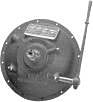 So, far we’ve seen that ordering a PTO is fairly easy. You just call us up and either give us the number from the inspection plate or we walk you through a few easy questions. But the big 14″ and 18″ NACD, Rockford, Twin Disc and WPT Power PTOs can be tricky. Especially, if you are ordering one without the number from the power takeoff inspection plate. Want an example? We received a call from an Air Force Base in Nebraska one Friday afternoon in January in the middle of a blizzard. They had several B1s inbound from the Middle East, due to land the next afternoon. Their Oshkosh runway snowplow had a front mounted snow blower with a 18″ Twin Disc manually engaged power takeoff clutch. The Twin Disc PTO was jammed and the snow was piling up on their main runway. Naturally, the Twin Disc inspection plate was missing.
A missing inspection plate can cause problems because these bigger PTOs use a variety of different facings linings including metallic, iron, and organic. Their main shafts and pilot bearings can also be different. Rockford and Twin Disc power take off clutches for Detroit Diesels are especially problematic because Detroit used different shafts and their flywheels take different pilot bearings. Especially in 14″ clutches. While most three plate, 14″ power takeoff assemblies use a 45 mm main shaft and run 100 mm pilot bearings, Detroit’s usually used a 35 mm main shaft and ran either a 72 mm or an 80 mm pilot bearing. In other words a Detroit Diesel engine won’t accept the standard 14″ Twin Disc or Rockford PTO. The chart below lays out what you should know when ordering a 14″ Twin Disc and Rockford power take off clutch.
| Pilot Bearing | Shaft Diameter/ Pilot Bearing ID | |
| Standard | 100 mm | 45 mm |
| Detroit | 72 mm | 35 mm |
| Detroit | 80 mm | 35 mm |
Manufacturers names, symbols and numbers are for reference purposes only and do not imply manufacturing origin.