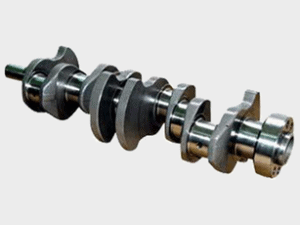
This Tech Tip is one of a number of tips we provide for the industrial engine community. It focuses on some the essentials when working with a new, used, or reconditioned crankshafts. While the focus is on Deutz and Perkins engines, much of the information should also be broadly applicable to many other brands of industrial engine.
Crankshaft Installation Tips
 First things first. All connecting rods, connecting rod caps, and main caps should be marked before disassembly, so they may be reinstalled in their original positions. Some main and connecting rod caps have code numbers stamped on them already from the factory. You can use these to make sure everything stays in order. If not, make sure your mark does not deform or interfere with the cap and its mating surface.
- Inspect the bores. Rod and main bearing bores should be inspected with a dial bore gauge just like a cylinder. This should be done with the cap secured and the bolts tightened down to the first torque setting. Any housing bore which measures out of spec should be resized or replaced. Line honing the block as well as the connecting rods should be part of every engine rebuilding procedure.
- Inspect the journals. The crankshaft’s journals must be within manufacturer’s tolerances. They must be smooth and free of burrs.
- Cleanliness is key. Before doing anything, make sure to wipe everything down with a lint free towel and degreaser. Don’t forget the oil passages too, a little bore brush or pipe cleaner can help you there. You should be able to wipe it off with a clear solvent and a white rag and see no residue on the rag after.
- No abrasives! Never use an abrasive on the bearing surface prior to installation. The bearing may be as thin as .0005″ (12.7 microns). Any abrasive will reduce bearing life. If something is out of tolerance stop and contact us to discuss your options.
- Install assembly lube on dry friction surfaces. The bearings should be installed on the rod or main saddles dry before crankshaft installation and then lubricated.
- Replace your hardware. This will help with piece of mind knowing the bolts and nuts you use to tighten everything down will hold up to the task of keeping your engine together.
- No nicks. Exercise extreme care when installing the rods. Try using the old bolts and a piece of rubber hose to add some length. This will help you guide the rod journal down to the crankshaft.
- Clean threads. Bolt threads should be cleaned and free of all debris and oil engine sludge.
- Check bearing clearances with Plastiguage.
- Properly torque all bolts. Don’t have the specs, let us know, we probably have the manual you need.
- Pre-lubricate (prime) the engine prior to starting. Many newer engine designs use a crankshaft driven oil pump that can’t be driven by a drill motor. While using a commercially available pressure lubricator facilitates pre-lubrication of virtually any engine, if you are going to use one, be very careful not to over-pressurize as we have seen oil coolers damaged and galley plugs dislodged which can result in catastrophic engine failure as the damage may not be readily apparent until it is too late.
 First things first. All connecting rods, connecting rod caps, and main caps should be marked before disassembly, so they may be reinstalled in their original positions. Some main and connecting rod caps have code numbers stamped on them already from the factory. You can use these to make sure everything stays in order. If not, make sure your mark does not deform or interfere with the cap and its mating surface.
For Deutz engine owners looking to purchase new components for their 1011 series engines use caution since while 1011 series engines share many parts in common, they are not all the same even within the same engine model. One relevant example is that while the Deutz BF3L1011 crankshaft has a hub size of 105mm; the BF3M1011 engine has a crankshaft with a hub size of 112mm. Sometimes these differences are due to the engine being an “L” engines or an “M” engine, like above, but there are plenty of other differences so be sure to call with your serial number so we can help you confirm you are getting the right part.
For parts and service for your Deutz, Perkins or Ford Industrial engine call us directly at 800.233.6539 or e-mail us at info@foleyengines.com. We stock, and have ready to ship, Deutz and, Perkins crankshafts. We also have a full century of experience (we were founded in 1916) helping people running Deutz, Perkins, and Ford Industrial Engines.
If you enjoyed this Tech Tip, here are a few others that you might find interesting; or feel free to search our Tech Tip library:
- Tech Tip #199: Deutz Engine Serial Number Locations Made Easy;
- Tech Tip #200: Rebuilding Connecting Rods; and
- Tech Tip #237: Deutz L Series vs. M Series 4-Cylinder Engines: How To Tell Them Apart.